Can you charge an EV if you live in an Atlanta apartment?
Yes, and the odds improved more than renters realize. Buildings permitted after Atlanta's 2017 ordinance must make 20% of parking spaces EV-capable, so newer buildings often have conduit and panel capacity already in place. For older buildings, Georgia Power's Make Ready Infrastructure Program funds the expensive electrical work, up to $300,000 per qualifying project installing 6 or more charging ports. The gap is rarely technical. It is that nobody at the building has asked properly yet.
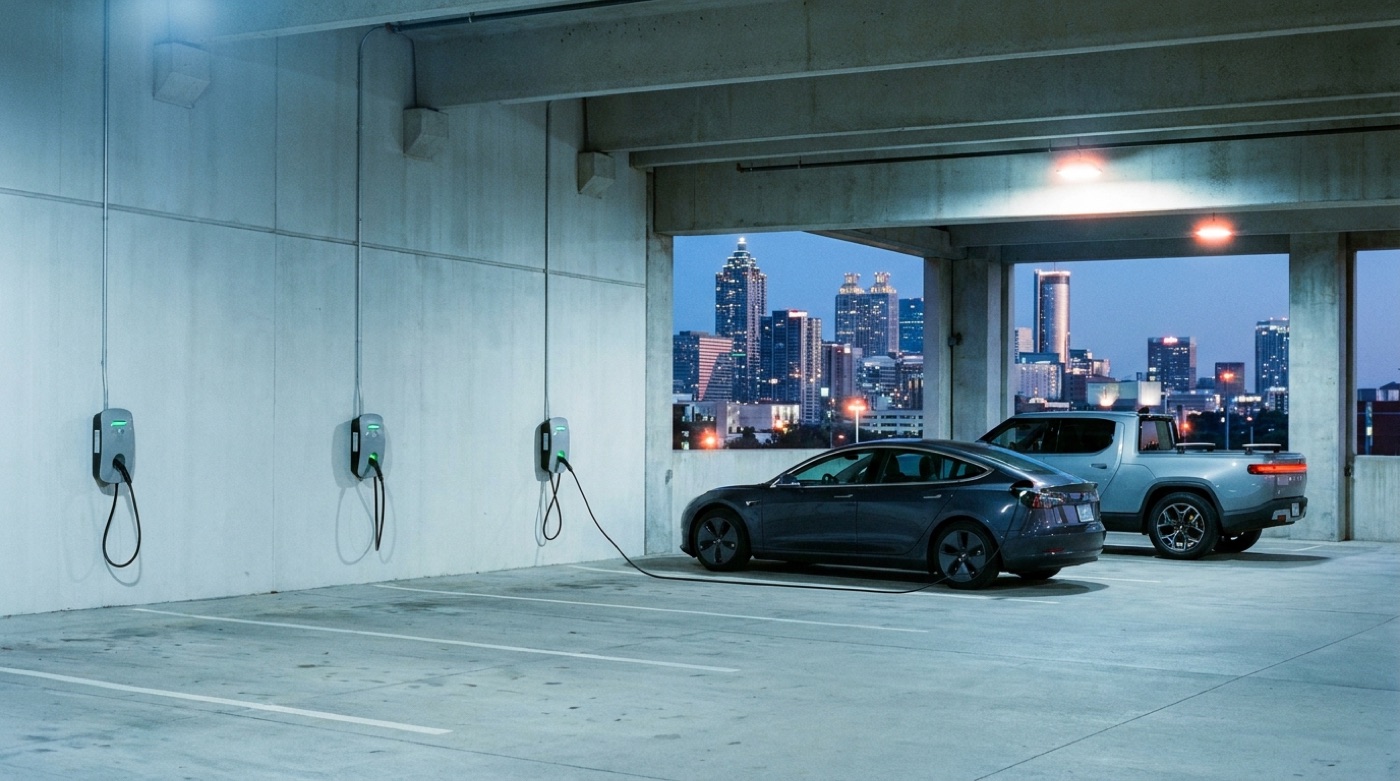
Why newer Atlanta buildings may already be EV-ready
Since 2017, the City of Atlanta has required new commercial and multifamily parking structures to make 20% of spaces EV-capable. EV-capable means the panel capacity and conduit pathways exist even if no charger is mounted. For these buildings, adding a working charger skips the expensive part of the job entirely.
If your building went up in the last 8 years, the first question to your property manager is exact: "Which of our spaces were built EV-capable under the 2017 ordinance?" A specific question signals you know the answer exists.
How does the Georgia Power Make Ready program work?
Make Ready is the single biggest lever for Atlanta multifamily charging. Georgia Power funds, installs, owns, and maintains the electrical infrastructure (transformers, panels, conduit, wiring) up to but not including the charger, for qualifying business and multifamily projects. Funding reaches $300,000 per project.
The qualifying bar: at least 6 charging ports, or at least one DC fast charger. The property buys and installs the chargers themselves plus extras like bollards and signage, while the utility carries the infrastructure cost that usually kills these projects.
One catch worth knowing before the board meeting. Since 2023 the program has covered publicly accessible chargers, which complicates gated parking decks. Confirm your property's eligibility with Georgia Power's electric transportation team before designing around the funding.
How to get a charger approved at your condo
Georgia has no right-to-charge law as of June 2026, so your HOA board controls the decision. Five steps that get to yes.
- Check existing capacity. Ask whether any spaces were built EV-capable and what the building's electrical headroom looks like.
- Write the proposal. Equipment spec, licensed installer, certificate of insurance, and a billing answer for the electricity. Boards say no to open questions, not to chargers.
- Name the funding. If the building could host 6 or more ports, bring Make Ready into the conversation. A shared-infrastructure project beats a one-off favor.
- Use a commercial-capable installer. Multifamily work means load studies, metering, and sometimes networked billing. Residential-only electricians are the wrong tool.
- Settle billing before install day. Per-session networked billing, a flat parking add-on, or submetering. The most common multifamily charging dispute is the one nobody priced.
How to ask your landlord for EV charging
Property managers respond to specifics and revenue, in that order. The written request that works names four things: what you want (a Level 2 charger at your space, or 2 shared chargers in visitor parking), who pays for usage (you, via networked billing or a monthly add-on), what it costs the building (potentially little, if Make Ready covers infrastructure), and what the building gets (a rentable amenity competing buildings already advertise).
Georgia registered over 100,000 EVs as of 2026, Hyundai is building IONIQ 5s and IONIQ 9s an hour down I-16, and EV-owning tenants are no longer an edge case. A building that cannot answer the charging question is starting to lose leases over it.
What does multifamily charging cost the property?
Networked Level 2 chargers run $2,000 to $6,000 per port installed, before infrastructure. Infrastructure is usually the bigger line, and the line Make Ready can erase for qualifying projects. Buildings already EV-capable under the 2017 ordinance skip most of that cost. After June 30, 2026, the federal 30C credit (which covered commercial projects up to $100,000) is gone, which makes Make Ready the remaining major funding source in Georgia. The timing details are in the tax credit deadline guide.
Frequently asked questions
Can apartment renters in Atlanta get EV charging installed?
Renters cannot install chargers themselves, but a specific written request, naming the 2017 ordinance and the Make Ready program, gets buildings to act far more often than a casual ask. Newer buildings often already have the capacity.
Can my HOA stop me from installing a charger at my condo?
Mostly yes. Georgia has no right-to-charge law as of June 2026, so the board controls common-element parking. A complete written proposal where the unit owner answers every cost question is the path that gets approved.
What does it cost a property to add EV charging?
$2,000 to $6,000 per networked Level 2 port installed, plus infrastructure. Make Ready can fund up to $300,000 of the infrastructure for projects of 6 or more ports.
Does Atlanta require new buildings to include EV charging?
New commercial and multifamily parking structures must make 20% of spaces EV-capable since 2017. Capacity and conduit, not necessarily working chargers.
Is Level 1 charging ever enough at an apartment?
For commutes under roughly 30 to 50 miles a day with a reliable outlet near your space, yes, as a bridge. It fails for long commutes and shared parking.